


By Eusebio Tanicala
In the ongoing conversation regarding instrumental music in worship within the Churches of Christ, hermeneutics—the method by which we interpret Scripture—is paramount.
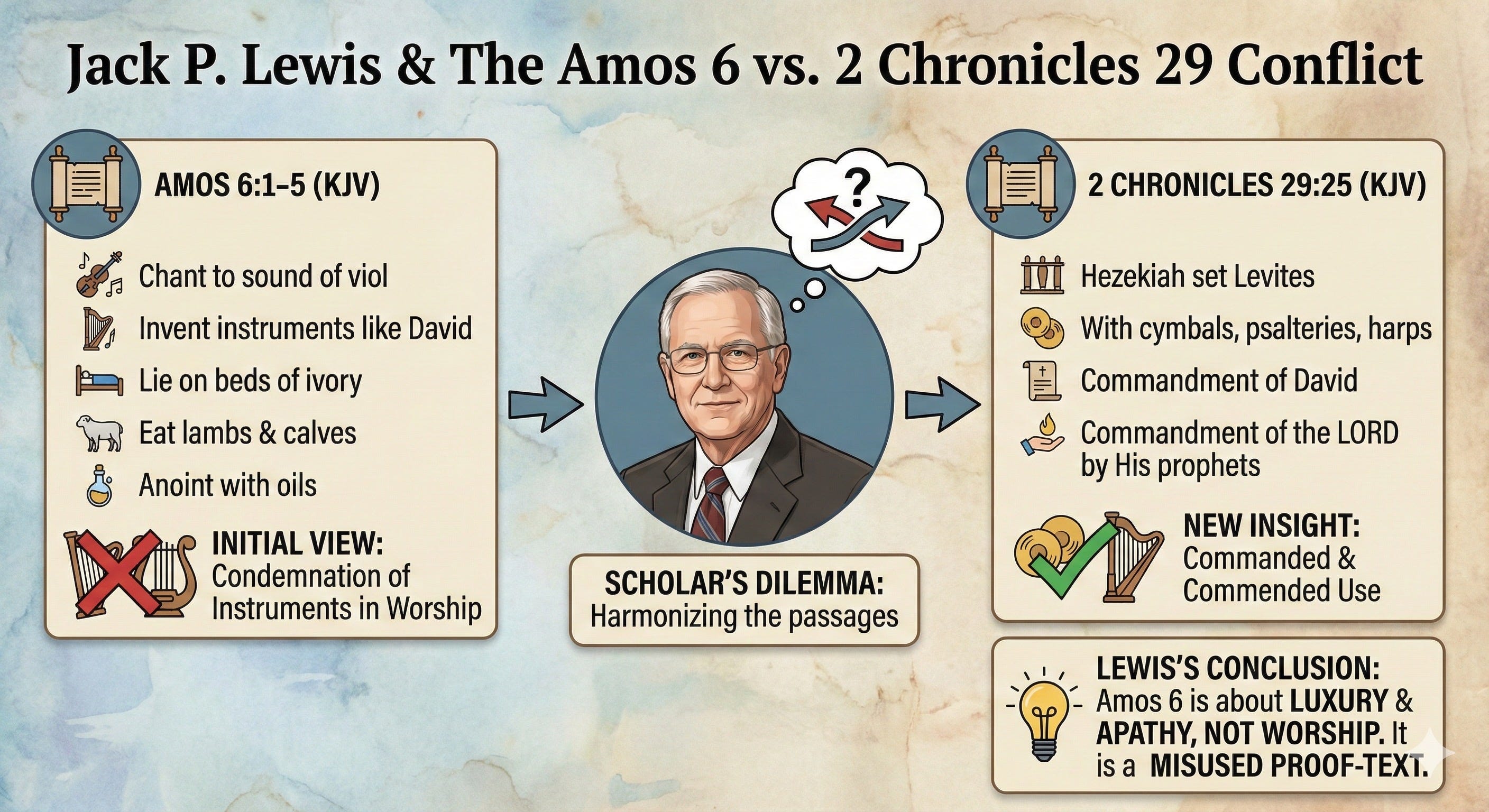
Brother Jack P. Lewis, a renowned and highly respected scholar within the Churches of Christ, addressed this very issue in the March 2008 issue of Truth for Today (edited by Eddie Cloer, published in Searcy, Arkansas). Brother Lewis authored many excellent articles on the subject of instrumental music in church worship, and I personally recommend this specific issue as a vital reference material.
However, regarding the specific usage of Amos 6:1-5 as a "proof text" against instruments, Brother Lewis made a significant admission.
The Confession of Jack P. Lewis
On pages 3 and 4 of the issue, Brother Lewis writes the following:
“I started my local preaching career about sixty-six years ago, fully convinced that the introduction of instrumentally accompanied singing in Jewish worship was presumptuous on David’s part and that the prophet Amos condemned him for it. The text on which I based this thinking was Amos 6:1-5: ‘Woe to them …that chant to the sound of the viol, and invent to themselves instruments of music, like David’ (KJV). The ancient rabbis said, however, that one should learn from all his teachers, and I have tried to make that a pattern of life.
“A denominational preacher whom I met at Sam Houston State University (then College) informed me that the use of instrumental music was commanded by David and was commended to King Hezekiah. He supported his statement by using 2 Chron. 29:25: ‘And he [Hezekiah] set the Levites in the house of the LORD with cymbals, with psalteries, and with harps, according to the commandment of David, and of Gad the king’s seer, and Nathan the prophet: for so was the commandment of the LORD by His prophets (KJV; emphasis mine).
“I had never considered that passage before. I will always be grateful that he shared his insights with me. However, when he insisted that singing was not a part of worship in the New Testament and that proponents of a cappella music are at fault for making it a part of worship, I differed, as I do now.
“How to harmonize the spirit of these two passages, one in Amos and one in 2 Chronicles, perplexed me. As I studied the prophets more, I became conscious that proof-texting is not a proper way to settle the meaning of a passage of Scripture. The use we were making then of Amos 6:5 had done just that. The setting of the passage in Amos is not at all a worship context. The other actions mentioned there are not worship actions; they are recreational. Look at the list: These people were lying on beds of ivory, eating lambs from the flock and calves from the stall, singing idle songs, inventing instruments, and anointing themselves with finest oils. They were accused of being unconcerned about the ruin of the northern kingdom, which Amos was threatening. Their careless, idle lifestyle and lack of insight into real conditions was being denounced. This old proof passage should no longer be cited as a part of the argument about worship. It has no convincing power.”
The Logic of the Text
Brother Lewis was a premier Old Testament scholar. He taught in graduate schools for many years and even participated in the translation committees for major Bible versions like the NIV. When a man of this caliber says that Amos 6:5 "should no longer be cited as part of the argument about worship" because it "has no convincing power," we must listen.
Indeed, those who understand the context of Amos—as well as the requirements of consistency and simple logic—can only shake their heads at preachers who still use Amos 6:5 to argue against musical instruments.
Consider the inconsistency of the argument:
I have repeatedly stated that the first thing condemned in that passage is the singing of idle songs. Why, then, do we sing? Why is only the second item on the list singled out as forbidden? Why do we ignore the first item and the other items that follow? Is this not a foolish system of interpretation?
If you argue that Amos 6 proves instruments are forbidden, consistency demands you also preach that it is:
Forbidden to sleep on comfortable beds (beds of ivory).
Forbidden to eat lamb or beef (calves from the stall).
Forbidden to sing secular or novelty songs (like those of Yoyoy Villame*).
Forbidden to use fine lotions or oils.
Why is the instrument banned, but the bed, the meat, and the lotion remain acceptable?
A Plea for Sound Hermeneutics
My plea to ministers who still rely on Amos 6:5 is this: Listen to the scholars who have dedicated their lives to study, who hold Ph.Ds from reputable universities, and who employ sound logic in their exegesis. Do not rely on interpretations that lack logical consistency or scholarly backing.
If we are to handle the Word of Truth correctly, we must stop using "proof texts" that do not actually prove our point.
Editor's Note: Yoyoy Villame was a Filipino singer known for novelty and comedic songs. The author uses him as a modern equivalent to the "idle songs" mentioned in Amos.
Verification Note
Source: The quote from Jack P. Lewis is authentic. It appeared in Truth for Today, March 2008, in an article titled "Questions I Have Been Asked About Instrumental Music."
Context: Jack P. Lewis was a staunch figure in the Churches of Christ (a cappella tradition). His admission here was not an endorsement of instrumental music in Christian worship, but rather a scholarly correction that Amos 6 specifically is a poor argument to use against it, as the passage condemns luxury and apathy, not worship methodology.