


For over a century, our beloved Churches of Christ in the Philippines—have preserved an invaluable heritage. We have steadfastly defended a deep commitment to sound doctrinal teaching, scriptural purity, and the cherished autonomy of every local congregation.
However, in our pursuit of “right doctrine,” we historically faced an unintended side effect: a quiet withdrawal from the tangible physical, economic, and civic struggles of the communities that we call home. We did not mean to withdraw, but our focus on the spiritual sometimes made it hard to see the physical needs right outside our doors.
How do we preach a transcendent, saving Gospel when our neighbor lacks clean water, basic medical attention, or a livelihood? Can we, as brothers and sisters in Christ, truly be “scripturally sound” if we remain socially silent?
These are not new questions, but they were lovingly and formally asked of our fellowship by one of our own, our dear brother Dr. Teofilo G. Alcayde (+). In his seminal 1992 doctoral dissertation at Baguio Central University, The Church of Christ in the Philippines: Its Involvement in Community Development, Brother Alcayde documented this paradox within our midst.
Based on data from church leaders and members across Luzon, Visayas, and Mindanao, Brother Alcayde’s exhaustive study reached a sobering conclusion: while our efforts in spiritual development were truly highly impressive, our involvement in civic, economic, health, educational, and social development was critically lacking. He looked at us and found that when it came to practical, physical pillars of the community—economics, health, sanitation—our involvement was evaluated as “less impressive” or “not extraordinary”.
It is not that we did not care. It is that our organizational set-up, while scripturally sound and allowing for the independence of each congregation, sometimes made it proving difficult to pool our resources for massive, complex socio-economic projects.
But Brother Alcayde did not write his critique as an obituary. He wrote it as a challenge to his brothers. He closed his study with a prophetic call to action, urging our congregations to transition from passive observers to active developers by establishing medical clinics, trade schools, and cooperative businesses. He urged us to train more students for fruitful services and not to remain extraordinary in only one area. He essentially provided us a map, leveraging a structure where we could show that physical benevolence and spiritual devotion are not mutually exclusive, but are two halves of a complete, biblical ministry.
Today, we are witnessing a beautiful, dynamic, spirit-filled response to that challenge. Driven by a passion for the lost and a heart for the hurting, modern Filipino disciples are proving that faith without works is dead. They have built on the map Brother Alcayde provided.
This transformation is realized through core operational modalities, integrated to solve the spiritual-secular divide and create a unified network of action.
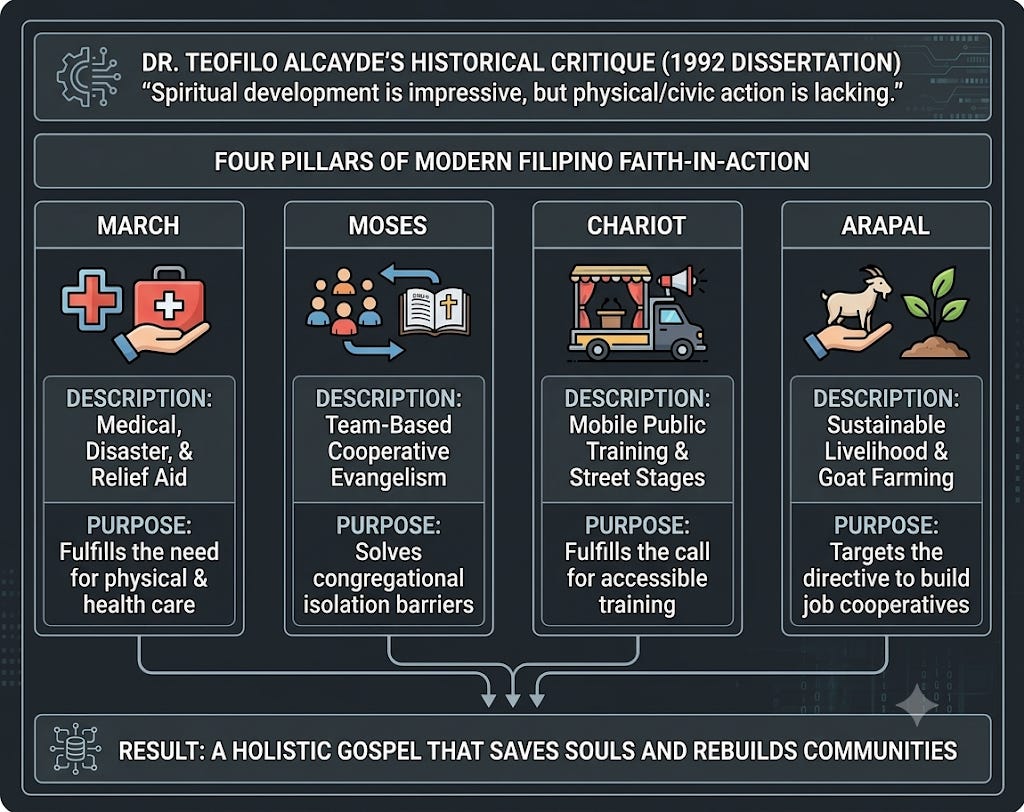
1. MARCH for Christ: Our Ministry of Mercy
Born in the aftermath of the devastating 1990 Baguio City earthquake, MARCH for Christ (Medical Action for Relief, Counseling and Healing) has become the hands and feet of Jesus, truly utilizing professional medical and volunteer personnel. Led by a dedicated team including the late brother Luis “Chito” Cusi, and supported by workers like physiotherapist Shemer “Shem” Sameon, MARCH has evolved from a crisis response group into our premier humanitarian arm. Its key focus on disaster response, medical and dental clinics, and holistic humanitarian relief perfectly fulfills the brotherly call for church-operated medical services and physical community care.
From delivering clean water and hot meals following volcanic eruptions to establishing a “MARCH Village” for long-term community development, this ministry proves that physical healing and relief is a powerful, living manifestation of our Father’s love.
2. MOSES & Gospel Chariot Missions: The Power of Mobilized Training
We have learned that we can break isolation through mobilized training. The deployment of the Philippine Gospel Chariot has revolutionized how our local congregations collaborate. This cooperative endeavor utilizes customized, state-of-the-art “gospel trucks” equipped with built-in baptismal pools and heavy-duty stages. This operational style allows us to break through isolation barriers and conduct coordinated regional campaigns.
When partnered with the MOSES (Mobile Outreach for Soul-saving, Evangelism, and Service) teams, they take the message of Christ directly to the streets. By utilizing a simple, structured training framework—like the globally proven “4 Fields of Discipleship”—they are not just conducting meetings; they are training and activating ordinary brothers and sisters to become multiplying agents of outreach. This approach breaks the historical isolation of our small, autonomous congregations and provides robust local social integration. It perfectly addresses the need to expand accessible, decentralized training for fruitful service in the church.
3. ARAPAL: Our Gospel of Sustainable Livelihood
Situating our efforts within the community, ARAPAL Christian Camp in Cebu is perhaps the most complete, long-term structural embodiment of a brotherly answer to economic and community development critiques. Directed by evangelist and dear brother Salvador “Sal” Cariaga, ARAPAL focuses on poverty alleviation through sustainable agriculture, specifically pioneering what Sal affectionately calls a “Gospel of Goats,” micro-enterprise, and vocational training.
Its permanent demonstration-farm model uses a “give-a-goat” loan program and resource stewardship. Impoverished local families are loaned a male and female goat, taught to breed them, and are integrated into composting, organic farming, and micro-business soap-making. This approach, transforming dependency into a sustainable cycle of work, dignity, and income, directly targets the recommendation to “initiate more cooperatives and business opportunities” to provide employment for our fellow men.
A Dynamic Future for Our Brotherhood
The Churches of Christ in the Philippines are moving. We are moving from purely doctrinal teaching to institutionalized social action. Our historical matrix of separation is being replaced by a unified network of action. Modern leadership has learned to steer our fellowship toward a healthy balance: maintaining our doctrinal focus while fully embracing our responsibility to heal, serve, and develop the communities that God has placed us in.
Brother Teofilo Alcayde’s critique was not an obituary; it was a loving map drawn by a brother who believed we could be more. Today, through structured endeavors that show that physical benevolence and spiritual devotion are not competing ideologies but two halves of a complete biblical ministry, we are finally following that map.
The Historical Assessment: Spiritual Dominance vs. Secular Absence
For decades, the standard pattern of Churches of Christ in the Philippines leaned heavily toward spiritual instruction and local congregational maintenance. Because each church operates under strict local autonomy with no centralized governing board, mobilizing broad socio-economic initiatives has historically proved difficult.
As evaluated in Dr. Alcayde’s study:
Spiritual development was found to be highly impressive.
Secular, civic, economic, and educational involvement was deemed “less impressive” or “not extraordinary”.