


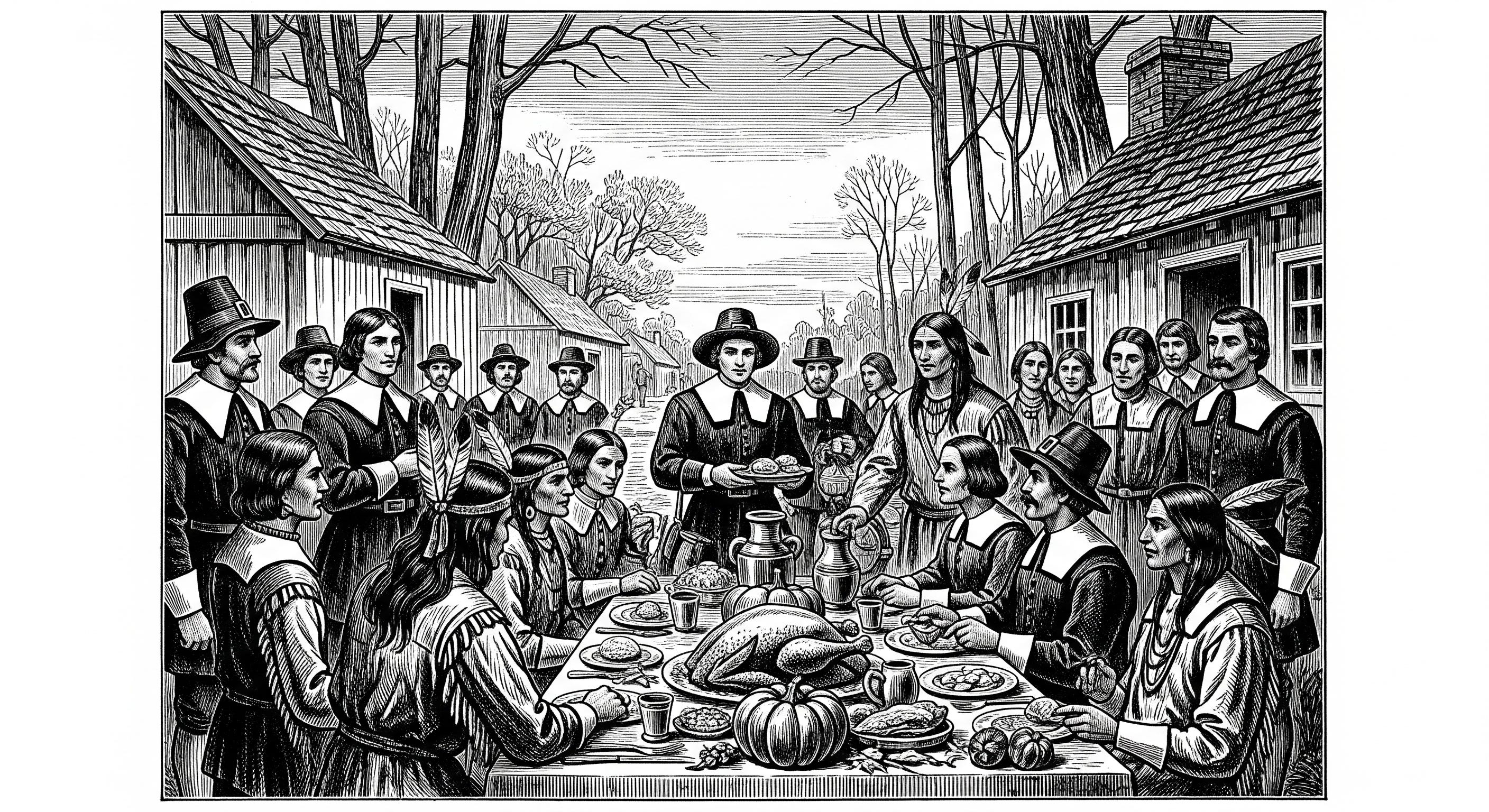
When we sit down for Thanksgiving, we often replay a comfortable, simple story: Pilgrims, Native Americans, a big feast, and a turkey. But if we peel back the layers of mythology, the true story of the 1621 harvest is actually a masterclass in vision, resilience, and the crystallization of culture.
The Visionary Rupture
Every great endeavor begins with a break from the status quo. For the Puritans, the journey wasn’t just a trip across the Atlantic; it was a theological rupture.
The Mission: Rejecting the “corrupt” institutions of the Old World, they initiated a “Covenant” mindset.
The Strategy: They viewed themselves as a “New Israel” exiting Egypt. This wasn’t colonization for profit (initially); it was an Exodus. Great movements start with a “Why” that is powerful enough to sustain people through the impossible.
Navigating the Unknown
Once the journey began, the settlers lived in a state of extreme risk management.
The Wilderness Test: They anticipated that the American wilderness would be their “desert wandering”—a test of spiritual mettle.
Providence as Data: They treated every weather pattern and crop yield as critical data points—feedback from ‘Providence’ on their performance. In this phase, the turkey was not yet a brand icon; it was a critical resource. It represented the practical, scalable solution to the immediate problem of survival.
The Culture of Conditional Blessing
Culture is defined by expectation. The Puritan culture was transactional and rigorous.
The Metric of Gratitude: They didn’t just hope for success; they expected that obedience would yield harvest.
The Biblical Blueprint: Drawing from the Leviticus Todah (Thank Offering) and the Feast of Tabernacles (Sukkot), they built a culture where gratitude was mandatory, not optional. They expected to “rejoice before the Lord” when goals were met.
Leadership Lesson: They didn’t wait for a calendar date to celebrate; they declared ‘Days of Thanksgiving’ in direct response to achieving specific milestones—a responsive approach to celebrating wins.
Strategic Alliances and Execution
This is where strategy hits the real world. The 1621 feast was the operationalizing of their theology.
Functional Resources: Why the turkey? It wasn’t symbolic; it was scalable. It was the most abundant protein available for mass participation.
The Stakeholders: The participation of the Wampanoag (Massasoit and his men) mirrored the biblical command to include the “stranger.” While history often romanticizes this alliance, it was a pragmatic moment of geopolitical cooperation in a harsh landscape.
Codifying the Legacy
Finally, we look at how the story is remembered—the branding. This is where the history was rewritten for national cohesion.
The Myth of the Seal: We love the story that Benjamin Franklin wanted the Turkey to be the national bird. The truth? It was a private letter to his daughter where he critiqued the Bald Eagle’s “bad moral character” and praised the Turkey’s courage. It was never a public stance, yet the myth persists because it aligns with our desired national identity: humble courage over imperial power. A powerful brand story often outlives the facts.
The Pivot: It took Sarah Josepha Hale in the 19th century and Abraham Lincoln during the Civil War to turn a regional Puritan custom into a national event. They recognized that a fractured nation needed a unifying symbol—and the turkey became that icon.
The Takeaway
Thanksgiving is more than a dinner; it’s a case study in how a group initiated a vision, navigated the anticipation of failure, established a culture of expectation, executed a participatory event, and ultimately left a legacy that outlasted them by centuries.
Ultimately, this evolution illustrates how a “Theological Experiment” transformed into an “Institutional Legacy.” The Puritans entered the wilderness not merely as settlers, but as hypothesis-testers in a laboratory with no safety net, betting that a society built strictly on their interpretation of the Bible would compel divine blessing. While the “experiment” was the existential risk taken in 1621, the “legacy” is the endurance of that ritual long after the specific Calvinist theology faded from the mainstream. By codifying what was once a specific spiritual response into a universal federal holiday, leaders like Abraham Lincoln ensured that the core values of resilience and shared gratitude would outlast the founders, becoming a permanent pillar of American society that we still repeat 400 years later.
What is the “Covenant” or vision your team is initiating this year? And what “wilderness” do you need to navigate to see it through?
Happy Thanksgiving.
#History #Leadership #Strategy #Thanksgiving #Puritans #Culture