


By Eusebio A. Tanicala
I am an avid student of church history. For many years, there were missing links as we tried to trace the spiritual genealogy of many Philippine brethren. Cotabato brethren told us of Pedro Asada who visited Antonio Villanueva before the outbreak of the Pacific War in 1941. That Pedro influenced Antonio to see the scriptural basis of not eating blood and other issues that eventually led the latter to severe ties with the Samahang Tagapagpalaganap ng Ebanghelio, the registered association of Christian Church/Churches of Christ preachers.
In 1978, I personally interviewed Antonio Villanueva in San Felipe, Tangtangan, South Cotabato. Antonio originally came from Nueva Ecija. He was among the thousands of settlers from Luzon in search of free land that was being awarded by the government. Brother Antonio told me that he and Pedro Asada were good friends in Luzon. That during church conventions, they would always stay together in one room. Antonio did not know from what province Pedro Asada came from although he surmised that he was from Cavite.
In September of 1999 during my visit with the family of Domingo Camaganacan and Veny Villanueva-Camaganacan in Talaibon, Ibaan, Batangas, I suddenly came face to face with history. There was in front of me in flesh and blood a link to a dim past – Mrs. Isidro Villanueva, mother of sister Veny Villanueva-Camaganacan.
Mrs. Isidro Villanueva claimed that she was baptized by Henry G. Cassell in 1928. She told me that she personally knew Pedro Asada. Pedro Asada moved his family from Calapan, Mindoro, to Mindanao before the Second World War. That a daughter of Pedro Asada, Aurora by name, was left behind in Mindoro because she was already married when the family sailed for Mindanao. Aurora Asada was the mother of Eliseo Sikat.
Eliseo A. Sikat, therefore, is the grandson of Pedro Asada. Eliseo and sister Veny Villanueva-Camaganacan were neighbors when they were young. Being children of church leaders, they knew each other well. And I personally knew Eliseo Sikat because he was my classmate in a Bible College in 1964. When we were classmates, I didn’t know that Eliseo was the grandson of Pedro Asada. That fateful day of September 1999 revealed to me the whereabouts of the missing links of our Philippine church history.
During a leisure trip to the Orient, George Pepperdine (founder of Pepperdine University in California) made Manila one of his stopovers. Pepperdine congregated with the Christian Church/Churches of Christ group at Cruzada, Quiapo, Manila.
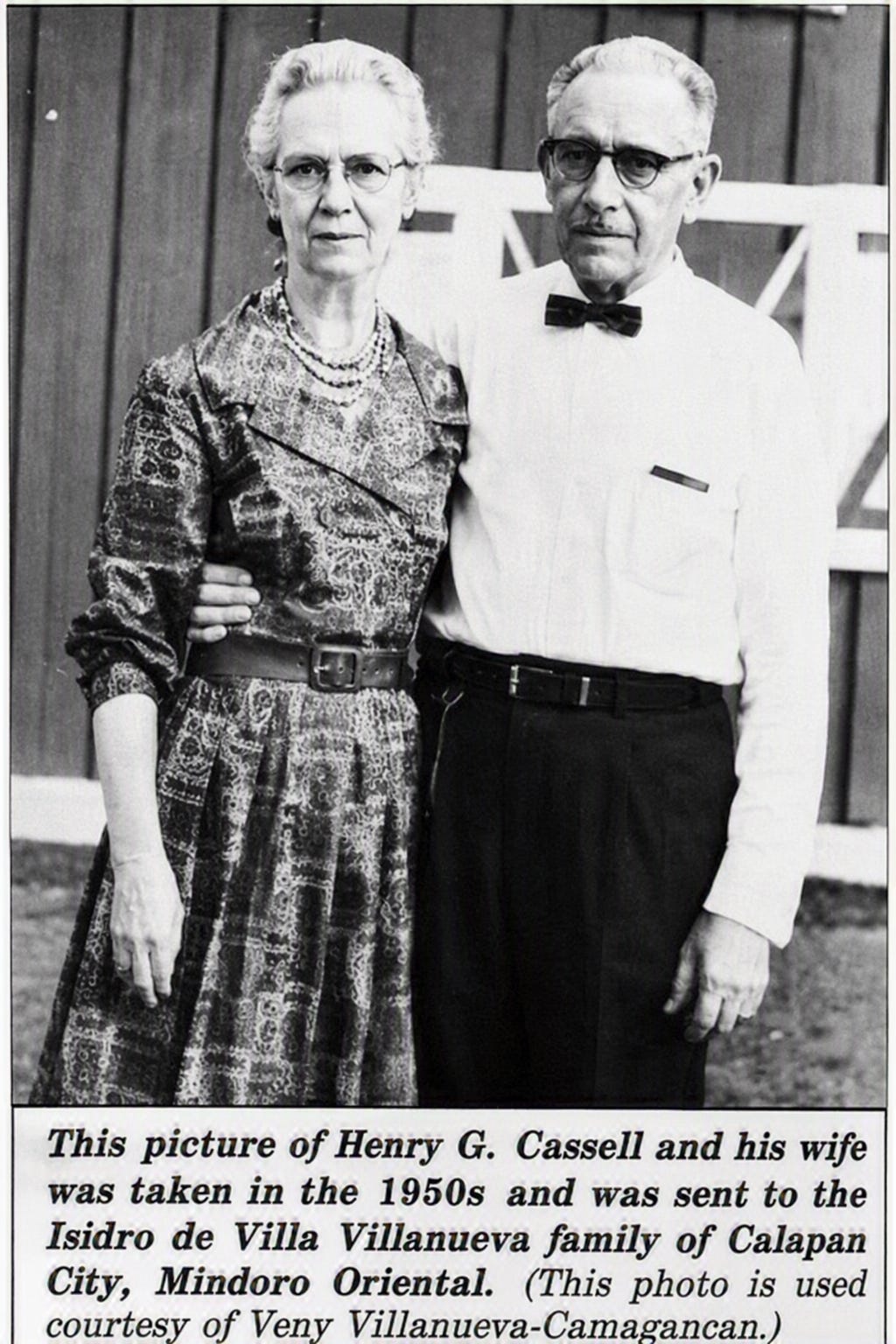
In 1927, George Benson, missionary to China was forced out of the mainland. The ship that brought foreigners out of China docked at Pulasahi in Mindoro. There George Benson preached several months, It was George Pepperdine who encouraged George Benson to consider the Philippines as a mission field should circumstances bring him out of China. When Benson left the Philippines, the Southwest Church in Los Angeles, California where Pepperdine attended sent Henry G. Cassell to continue the work in Mindoro. But because the weather in Mindoro was not favorable to the health of the Cassell family, they moved to Manila. From Manila, Henry G. Cassell would make occasional preaching trips to Mindoro.
According to brother Timoteo Lomanang of Naujan, Oriental Mindoro, based on his personal recollections and from stories of his father, Carlos Lomanang, Cassell personally chose Pedro Asada as his interpreter and companion during trips to Mindoro. Asada was one among the several young Tagalog preachers that would go in and out of the church that met along Cruzada Street, Quiapo, Manila.
Cassell succeeded in clarifying the issues with Asada. Issues that separated the Christian Church/Churches of Christ from the Churches of Christ. Eating of blood, Christmas and holy week celebrations were among the major practices dropped by Asada which he discussed with Antonio Villanueva in their farm settlement in the wilderness of Cotabato before the outbreak of the Pacific War. Antonio Villanueva had at that time started preaching to Cornelio Alegre, Laureano Belo and others in Cotabato. And Asada discussed these issues with them, too.
Cassell had also converted other families in Calapan, Mindoro during his visits from 1928 to 1941. Benson’s work of few months was around Pulasahi-Roxas and Mansalay many kilometers south of Calapan City.
In December 1941, the Pacific War broke out. Henry Cassell and his wife became prisoners of the Japanese Imperial Army and were interred at the University of Santo Tomas in Manila. When the liberation of Manila was completed in 1945, the Cassells, like thousands of American civilians caught by the war in Manila, were shipped back to the States. Brother and sister Cassell suffered much during the many months of incarceration and were very sickly when they sailed back to America. The Cassells continued corresponding with the Isidro Villanueva family in Calapan City, Mindoro in the fifties and early sixties.
Thus, we see the links, circumstances, and influences. We saw George Pepperdine and George Benson. There was George Pepperdine and the Southwest Church of Christ and Henry G. Cassell and his wife. Cassell who picked up Pedro Asada as his interpreter from among several Samahan preachers. We see Pedro Asada visiting Cotabato and influencing Antonio Villanueva, Cornelio Alegre and Laureano Belo, among others. And many brethren were influenced by other early church leaders like Melchor Fontanilla, Remigio dela Torre, the de Castro brothers, Fabian Bruno and several others.
We see Cassell and Asada in Calapan, Mindoro influencing the Lomanang family, the Menor family, the Sikat family, among others.
SATURDAY, AUGUST 12, 2006