


By Dr. Eusebio A. Tanicala
A Personal Encounter with History
In September 1999, a visit to the family of Domingo and Veny Camaganacan in Talaibon, Ibaan, Batangas, brought me face to face with a living link to our church’s dim past. There, I met Mrs. Cleotilde Villanueva, the mother of Sister Veny.
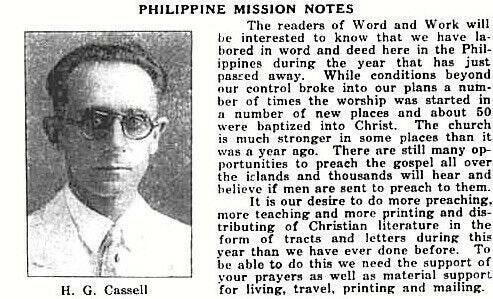
Mrs. Villanueva shared two astonishing facts. First, she was baptized in 1928 by the American missionary Henry G. Cassell. Second, she personally knew Pedro Asada, a key figure in our early history.
She recounted that Pedro Asada moved his family from Calapan, Mindoro, to Mindanao before the Second World War. However, one daughter, Aurora, was left behind in Mindoro as she was already married. This Aurora Asada, she explained, was the mother of Eliseo A. Sikat.
The connection struck me immediately. Eliseo Sikat was my classmate at the Philippine Bible College in 1964. All those years ago, I had no idea my classmate was the grandson of Pedro Asada. Sister Veny and Eliseo, being children of church leaders in the same area, knew each other well as neighbors. That fateful day in 1999 revealed the very “missing links” I had sought in our Philippine church history, connecting my own generation directly to the pioneers.
The Foundations: Pepperdine, Benson, and Cassell
The story of the Church of Christ in the Philippines begins with a series of providentially timed events.
During a leisure trip to the Orient, George Pepperdine (founder of Pepperdine University) made a stop in Manila. He congregated with the “Christian Church/Churches of Christ” group that met at Cruzada, Quiapo, Manila.
In 1927, another American, George Benson, a missionary in China, was forced to evacuate the mainland. The ship carrying him and other foreigners docked at Pulasahi in Mindoro. It was George Pepperdine who had previously encouraged Benson to consider the Philippines as a mission field if circumstances ever forced him out of China. Benson preached for several months in Mindoro, planting seeds of the gospel.
When Benson eventually left, the Southwest Church of Christ in Los Angeles—where Pepperdine attended—sent Henry G. Cassell to continue the work in Mindoro. However, the climate in Mindoro was not favorable to the Cassell family’s health, prompting them to move to Manila. From their base in Manila, Henry G. Cassell would make occasional preaching trips back to Mindoro.
The Crucial Link: Cassell and Pedro Asada
According to the recollections of Timoteo Lomanang of Naujan, Oriental Mindoro (based on his own memories and the stories of his father, Carlos), Henry Cassell chose Pedro Asada as his interpreter and travel companion for his trips to Mindoro. Asada was one of several young Tagalog preachers associated with the Samahan (Christian Church) group meeting on Cruzada Street in Quiapo.
This partnership proved to be the pivotal moment of doctrinal clarification. Cassell worked closely with Asada, clarifying the theological issues that separated the Churches of Christ (non-instrumental) from the Christian Church/Churches of Christ (instrumental). Key practices such as the eating of blood, Christmas celebrations, and Holy Week observations were discussed and subsequently dropped by Asada.
This “restored” message, as clarified by Cassell, is what Asada carried with him.
The Gospel Spreads Through Filipino Pioneers
Pedro Asada’s influence became the bridge linking the American missionary effort to the indigenous spread of the church across the islands.
To Mindanao: Before the Pacific War, Asada moved his family to a farm settlement in the wilderness of Cotabato, Mindanao. There, he met Antonio Villanueva, who had already begun preaching to men like Cornelio Alegre and Laureano Belo. Asada discussed the doctrinal issues Cassell had clarified with him, influencing Villanueva and this entire group, which would become a bedrock of the church in Mindanao.
In Mindoro: Cassell’s work, reinforced by Asada, continued from 1928 to 1941. While Benson’s initial work was in the Pulasahi-Roxas area, Cassell’s efforts were centered further north in Calapan. There, they converted and influenced several key families who would become pillars of the church, including the Lomanang family, the Menor family, and the Sikat family (Eliseo Sikat’s relatives).
The Interruption of War and Lasting Connections
In December 1941, the outbreak of the Pacific War brought this work to a sudden halt. Henry Cassell and his wife were declared enemy aliens by the Japanese Imperial Army and were interned at the University of Santo Tomas in Manila.
They suffered greatly during their long incarceration. When Manila was liberated in 1945, the Cassells, along with thousands of other civilians, were repatriated to the United States. Though they were very sickly when they sailed home, their connection to the Philippines remained. The Cassells continued to correspond with the Isidro Villanueva family in Calapan City, Mindoro, throughout the 1950s and early 1960s.
A Chain of Faith
We can therefore trace the series of events and relationships that established the Church of Christ in the Philippines. It began with George Pepperdine’s influence, leading to George Benson’s work in Mindoro, which in turn resulted in Henry G. Cassell being sent by the Southwest Church.
Cassell’s vital contribution was clarifying the church’s distinct message to Pedro Asada. Asada then became the key link, carrying this teaching to two primary fields: Mindanao (influencing Antonio Villanueva, Cornelio Alegre, and Laureano Belo) and Mindoro (with Cassell, influencing the Lomanang, Menor, and Sikat families).
Although these men were foundational, other early leaders like Melchor Fontanilla, Remigio dela Torre, the de Castro brothers, and Fabian Bruno were also instrumental. This history was built from the joint efforts of American missionaries and the dedicated Filipino preachers who embraced the message and carried it forward.