


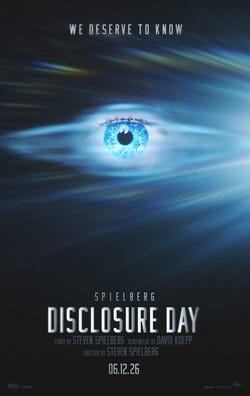

The dramatic core of Steven Spielberg’s movie, Disclosure Day, is built on the widespread cultural assumption that confirming the existence of extraterrestrial life would inevitably dismantle organized religion, particularly Christianity. However, an examination of Scripture, diverse theological paradigms, and modern social data suggests that Christian doctrine possesses the necessary conceptual framework to integrate the existence of a populated universe.
The Universal Scope of Biblical Creation
The assertion that alien civilizations would invalidate Christian thought often relies on the misconception that the biblical deity is limited strictly to Earth. Conversely, biblical authors consistently described a Creator with universal reach.
The Bible’s opening passage establishes an expansive, cosmic jurisdiction:
”In the beginning God created the heavens and the earth.”
This scope is further reinforced in the Old Testament, where the Creator’s authority is explicitly extended to the celestial realm:
”You alone are the Lord. You made the heavens, even the highest heavens, and all their starry host, the earth and all that is on it, the seas and all that is in them. You give life to everything, and the multitudes of heaven worship you.”
New Testament writings expand this perspective further, identifying the divine as the architect of the entire universe rather than a localized deity. Paul the Apostle, writing to the Colossians, describes a Christocentric universe:
”For in him all things were created: things in heaven and on earth, visible and invisible, whether thrones or powers or rulers or authorities; all things have been created through him and for him.”
Similarly, the author of Hebrews characterizes the Son as the agent of universal creation:
”...but in these last days he has spoken to us by his Son, whom he appointed heir of all things, and through whom also he made the universe.”
From a traditional theological standpoint, any biological life discovered within the cosmos would be categorized as part of the broader created order, existing under the same divine authority.
Alternative Perspectives: The “Demonic Hypothesis”
Not all religious academics dismiss the possibility of ETI as a simple theological non-issue. Some proponents of the “Demonic Hypothesis” view extraterrestrial phenomena through the lens of spiritual warfare rather than biological discovery.
Scholars such as Monsignor Stephen Rossetti and the late Fr. Seraphim Rose have argued that the anomalous, physics-defying characteristics often attributed to Unidentified Aerial Phenomena (UAP) mirror historical accounts of demonic manifestations. Adherents of this theory caution that modern extraterrestrial lore may advance spiritual ideologies that conflict with scripture, potentially grooming the public to prioritize a technological redeemer over the traditional Christian understanding of the divine.
Sociological Resilience and the ETI Myth
Despite concerns about a potential clash between faith and astrobiology, empirical research suggests that the general religious public is unlikely to face a crisis of faith upon the discovery of extraterrestrial life.
While secular commentators frequently forecast a religious collapse following first contact, the Peters ETI Religious Crisis Survey indicates otherwise. This research, conducted by theologian Ted Peters, involved a survey of over 3,000 individuals—including both secular participants and various Christian groups. The study found that most religious believers do not anticipate that the discovery of alien life would compromise their core convictions. Interestingly, it was the secular participants who were most inclined to predict a religious collapse, projecting their own expectations of crisis onto religious communities.Conclusion
The narrative tension regarding religious vulnerability portrayed in contemporary media appears more as a storytelling device than a reflection of sociological reality. Between the expansive cosmic scope defined in biblical scripture and the documented resilience of practitioners, Christianity remains equipped with the conceptual tools required to navigate a densely populated universe.
-----
References:
Peters, T. (2013). “Would the Discovery of ETI Provoke a Religious Crisis?” Astrobiology, History, and Society. NASA/ADS Abstract
Peters, T. (2014). “Astrotheology: A Constructive Proposal.” Zygon: Journal of Religion and Science. Zygon Journal