


By Eusebio Tanicala
(This writer was asked to comment on a submitted 1975 Q&A article by brother Guy N. Woods regarding Christmas observance. This is the second article in our three-part series.)
Etymology
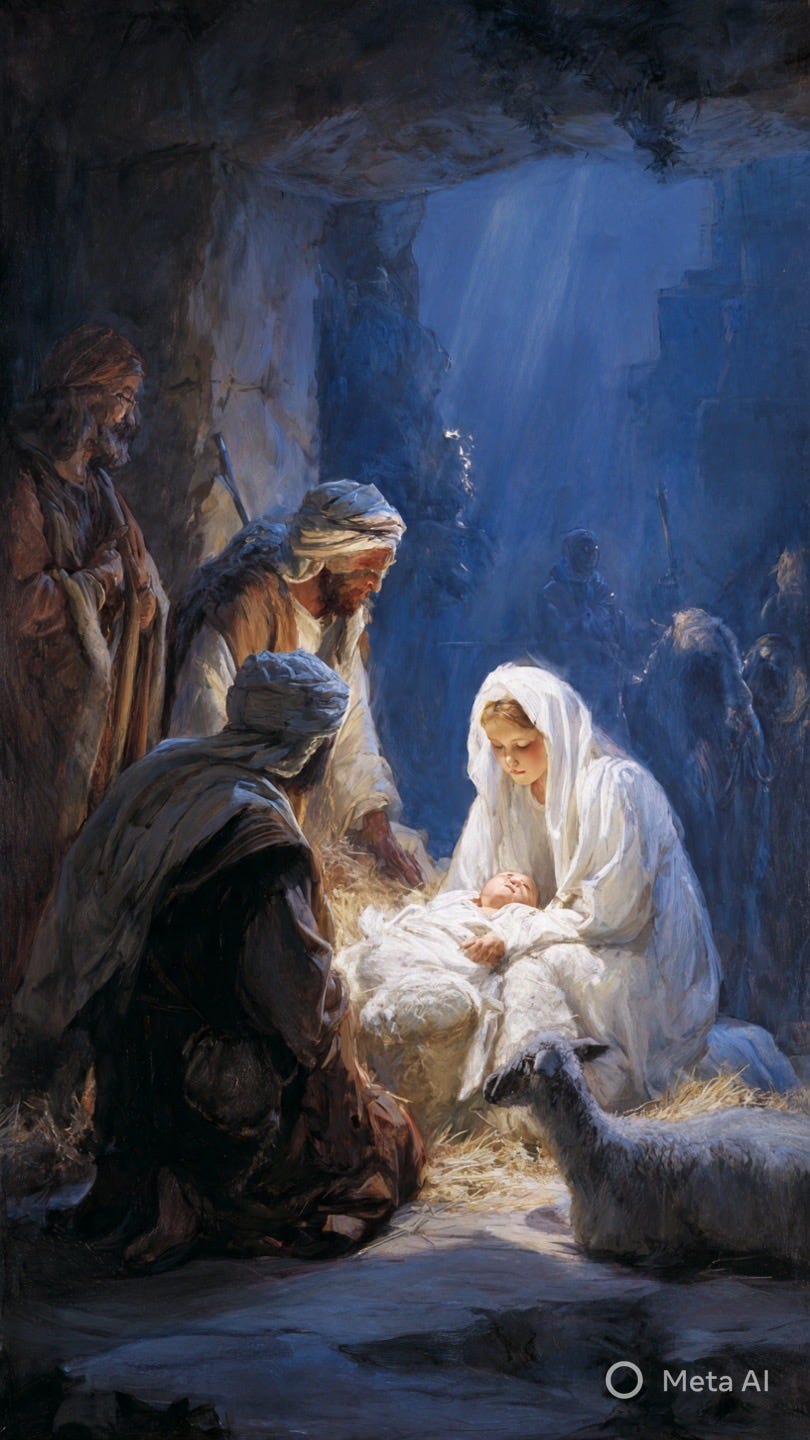
I believe that the English word "Christmas" is a compound word: Christe + masse, adopted from Latin. Funk & Wagnalls Standard Dictionary of the English Language (Vol. 2, p. 783, © 1970) reveals this: "OE, maesse < LL messa, dismissal < L, missa, pp. fem. mittere, send, dismiss." Please check a large unabridged English dictionary to verify the etymology.
The basic meaning of the suffix "mas" is "to send" or "to dismiss." It refers to the "sending of Christ" from heaven into our world. God sending Christ to dwell with humanity is the true meaning of the word "Christmas."
Early church history tells us that in the western part of the Roman Empire, where Latin was the dominant ecclesial language, immersed believers and catechumens (converts under instruction) mixed together in one assembly hall for teaching. However, in the later part of the service, when the bread and wine were consecrated and distributed, the catechumens were sent out from the assembly. In Latin, the verb used to dismiss those catechumens was derived from mittere—"to send" or "to dismiss."
The habitual practice of sending out the catechumens using the verb form masse (followed by the communion) developed into the term misa. Eventually, the part of the service celebrating the Eucharist—the sacrifice of Christ—was called the misa (Mass) because the non-members were "sent out."
Based on this background, while the misa or Eucharist recalls His death, the suffix itself refers to sending. Therefore, masse was originally related to the sending out of the catechumens. Since Christ was the One sent by the Father into the world, "Christmas" properly refers to the sending of Christ. Just as the dismissal comes from the verb mittere (to send), Christmas relates to the sending of Christ to our world—His becoming flesh, which John 1:14 and Hebrews 10:5 clearly affirm. New Testament writers testify that Christ was sent by the Father (John 3:16–18; 7:29; 20:21; Matthew 10:40; Luke 4:43; 9:48; Colossians 2:9).
If our thinking centers on the suffix "mas" coming from mittere (to send), and we acknowledge Christ was sent from heaven to earth to fulfill the proto-gospel of Genesis 3:15 (confirmed by Galatians 4:4), my conclusion is that the Bible teaches about Christmas. There is Christmas in the Bible in the sense that Christ was sent from heaven to tabernacle with man.
This is why Christ Jesus is also called Immanuel (Isaiah 7:14; Matthew 1:23). Immanuel is another compound word: Imman (abiding/indwelling) + El (God). It means "God abides with us." There is a popular Christmas song titled "The First Noel." Noel is derived from the ending of the name Immanuel. It is called "The First Noel" because it tells the story of the night Christ was born in Bethlehem. Essentially, Noel means Christmas.
Why December 25?
It is true that the Bible does not say December 25 is the actual birth date of Christ in the flesh. However, let us understand the background of assigning December 25th for the observance of Christ Jesus’ birth.
I encourage you to read extensively about the Roman feast called the "Saturnalia Festival." Some writers say it was celebrated from December 16–22, others say December 17–25. A notable tradition of this festival was choosing a "bad person" to personify evil in the community; this person was put to death at the conclusion of the festival to signify the putting away of evil. During these festivities, the populace indulged in liquor, naked people went house-to-house singing, and there was widespread sexual license and orgies.
Related to the Saturnalia was the Sol Invictus. The Sun was considered a deity that remained unconquered. Astronomically, December 22 is the Winter Solstice—the day the Sun is observed to be farthest from the equator when viewed from the northern hemisphere. The ancients believed the Sun stood still for a few seconds before moving back toward the equator, bringing warmer weather and longer days until the Summer Solstice in June. People celebrated this "coming back to life" of the Sun God on December 24–25. They were impressed by the Sun’s ability to return and give life to the earth. This was the Sol Invictus (The Unconquerable Sun).
Church history records that in the second and third centuries, believers observed Christ’s birth on various dates, from January to as late as May.
Considering the idolatrous celebration of the Saturnalia and the varying dates of the Messiah's birth in different congregations, the Bishop of Rome took it upon himself to metamorphose pagan traditions into a Christian festival. Bishop Liberius, around A.D. 354, made an ecclesiastical declaration that December 25 be considered the day to celebrate Christ Jesus’ birth.
The goal was to replace honoring the Sun God with honoring the Son of God, Jesus Christ. Instead of wild, sensual orgies, Christian values would govern the festivities. This authority was based on the Latin Church’s claim (from Matthew 16:16–20) that Peter was the prince of the Apostles and the Bishop of Rome was his successor, with the right to bind and loose. While this claim was objected to by the patriarchs of Alexandria, Jerusalem, Antioch, and Constantinople, it persists to this day.
This historical background explains why December 25th became the basis of observance. If you were a preacher in Rome between A.D. 326–360, wanting to drown out the wild Saturnalia and banish the belief in Sol Invictus, how would you have evaluated Bishop Liberius’ declaration?
The Bible does not say Christ was born on December 25th. Neither does it say your loved ones died on November 1st. Is it consistent to make noise against a birth observance on December 25th while flowing with the community regarding death observance on November 1st ("All Saints Day")?
Pros and Cons
Many conservative Bible believers invoke the line: "The Apostles did not celebrate the birth of Christ; therefore, Christmas should not be made a religious belief." They claim we are commanded only to celebrate His death and resurrection (1 Corinthians 11:17–34).
On the other hand, the "pros" invoke Romans 14:5–12:
"One decides that a certain day is superior, while another holds every day in esteem. Let each be fully persuaded in his own mind. He who thinks highly of a day does so for the Lord... Why do you condemn your brother? ... Each one of us shall give an account of himself to God."
The view of the "pros" is that they observe the day as a positive community celebration in honor of Christ Jesus, provided the activities do not honor idols and it does not become a binding church ordinance. It is an individual’s private act in consonance with community tradition, taking advantage of a season when people's hearts are focused on the Messiah.
As brother Guy N. Woods argued, the original pagan meaning of some acts and terminologies no longer adheres to activities today. For example, the names of our days and months originated from paganism (Januarius, Mars, Thor, Saturn, Sun, Moon). We do not worship these ancient deities, yet we use the names. We follow the "Gregorian Calendar," invented by a Roman Pope, yet we do not submit to the Pope’s rituals. The pagan origins have been detached; today, they are just names and dates.
Is there a possibility of extracting principles from the angel’s message in favor of observing Christ’s sending?
"The angel said to them: 'Do not be afraid, for behold! I bring good news with great joy to all people. Today in David’s city a Savior is born...'" (Luke 2:10–12)
Can we celebrate Christmas with joy? Can we sing praises as the angels did? Can we construct a Belen (nativity scene) in the corner of a receiving room? Can we sing "Silent Night" and "The First Noel," as long as we avoid making a definitive pronouncement that He was born on December 25th?
Consider also Apostle Paul’s dogma in 1 Corinthians 9:19–23:
“I have become all things to all men, that by all means I might save some."
Can a Christian observe Christmas for the sake of the Gospel during the Yuletide season?
Undas (All Saints Day)
In our Philippine culture, consider Undas (November 1st). Ancient Ilocanos had a festival called Kiring—a day of remembering dead relatives and offering food and drinks called atang. It was a day to make native cakes with the first sugarcane harvest. Those with wooden sugarcane pressers (dadapilan) would cook rice flour with juice in a large metal vat (siliasi). When the dudol (rice cake) was cooked, they would shout to alert neighbors to come and partake. The first slice was offered to the anitos.
When the Spaniards arrived, they brought their "Halloween" culture. Later, the Americans (who occupied the Philippines in 1898) were also soaked in this culture. Soon, Filipinos made November 1st a legal holiday—Todos los Santos or "All Saints Day."
Is "All Saints Day" a positive Christian culture? Or should church members call it a pagan invention and avoid it? The Bible says:
"It is better to go to the house of mourning than to go to the house of feasting, for that is the end of all men; and the living will take it to heart... The heart of the wise is in the house of mourning, but the heart of fools is in the house of mirth." (Ecclesiastes 7:2–4)
Is our community better off with an "All Saints Day" holiday where we remember our dead, or without it? Is it better to clean our cemeteries, offer fresh flowers, and sit beside the grave marker of a dear one, rather than having no such day at all?
The Apostles did not practice "All Saints Day." Yet, if one does not object to observing Undas as a legal holiday, is it consistent to object to Christmas Day as a legal holiday? This is acceptable provided one does not make it a church ordinance, nor offer prayers and food on the puntod (grave).
Consistency in Application
Note Acts 16:3 regarding Paul. He circumcised Timothy "because of the Jews," even though he preached elsewhere that circumcision had no benefit. However, in Galatians 2:3–4, Titus (a Greek) was not compelled to be circumcised. Paul stood firm on doctrine but yielded on expediencies. He became a Jew to the Jews and a Gentile to the Gentiles.
Holy Week?
Did the Apostles teach the observance of "Holy Week"? No. Yet, does our fellowship have activities during this time? Yes. Many churches of Christ sponsor Bible Camps, Lectureships, and Awitang Papuri during the holidays of Wednesday through Sunday of Lent. We flow with the community’s holiday schedule but adjust the activities—replacing the Siete Palabras ritual or processions with positive Bible studies.
If we have adjusted Holy Week (which follows the Roman Catholic calculation of the moon rather than the Jewish Passover) into positive activities, why do many reject the December 25th holiday? If we accept the "Holy Week" holiday for convenience and opportunity, we should be consistent regarding the Yuletide holidays.
Olympic Games
The Olympic Games originated in pagan Greece in honor of Zeus. Participants competed naked. Yet, Apostle Paul used these games as illustrations in his epistles (1 Corinthians 9; Hebrews 12). Have the games not been refined and detached from religious ideas? Our educational system includes athletics borrowed from these pagan games. Should we reject sports because of their origin? No.
Conclusion
The question to be asked today is: Can one participate in the observance of Christmas (the sending of Christ into the world) as long as it is detached from pagan deities and myths?
(NOTE: Our third and last article in this series will discuss popular beliefs and items of Christmas observance, such as the Christmas Tree, Gift Giving, Santa Claus, Misa de Gallo, lanterns, etc. We shall determine which are myths to be avoided and which are positive customs. We invite you not to miss the forthcoming article.)