


Exploring the etymology of the holiday—is it a "Mass for the Dead" or a celebration of the "Sent One"?
By: Eusebio Tanicala
In Part 1, we established that many words we use daily—like Thursday, Saturday, and January—have pagan origins, yet we use them with a secularized meaning that does not violate our conscience.
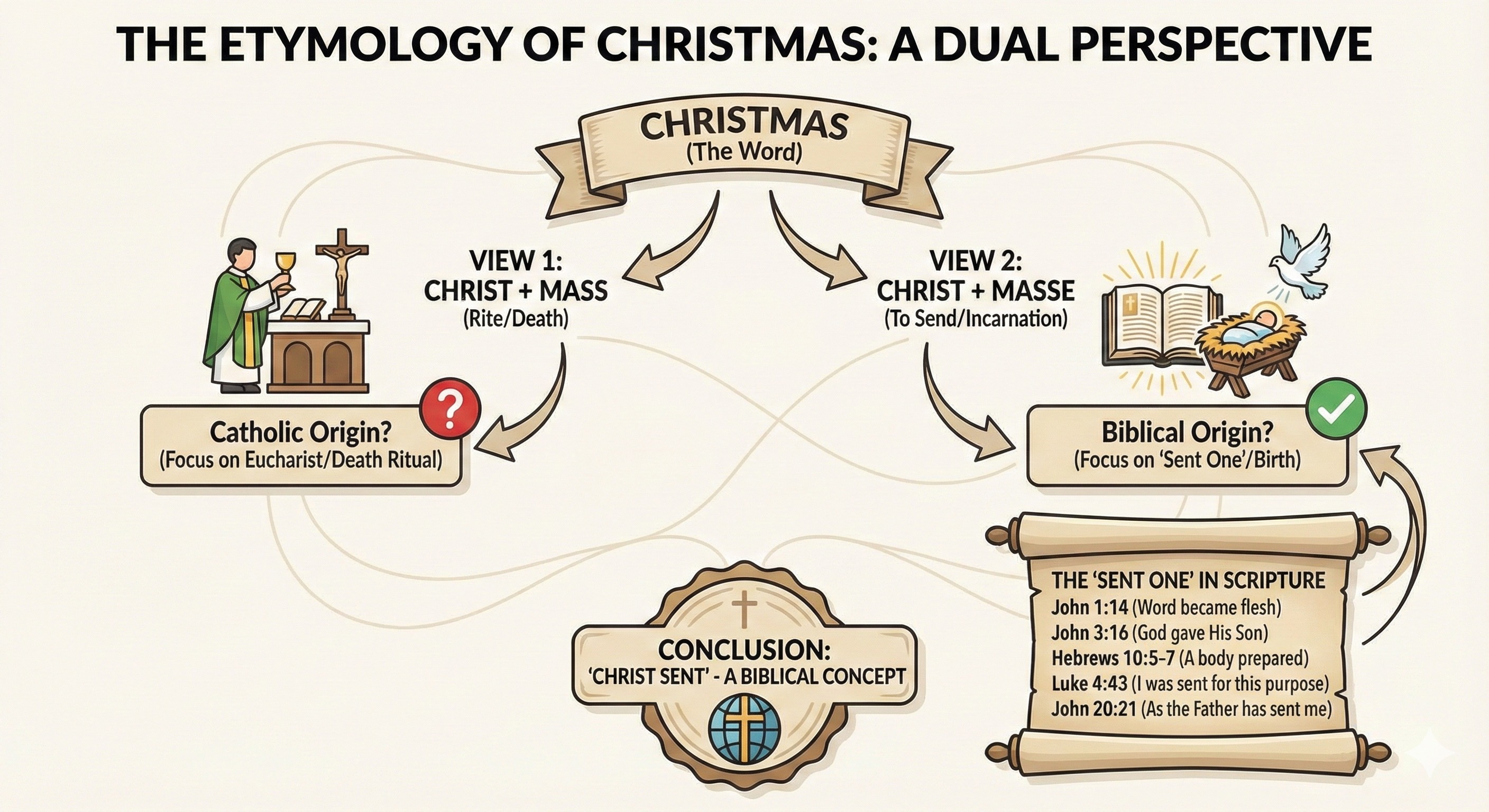
In this second installment, we address the specific etymology of the word "Christmas." Is it possible for church members to view this term through a biblical lens? To answer this, we must look at where the word actually comes from.
View 1: The "Christ + Mass" Objection
The most common objection to the holiday is that the word is a combination of "Christ" and "Mass."
Many define the suffix "mass" as "a rite or commemorative ceremony." This view suggests the suffix is derived from the Roman Catholic sacrament of the Eucharist—the consecration of bread and wine by a priest to be consumed by the congregation.
The theological problem here is that the "mass" ritual specifically remembers the death of Christ (offering His body and blood), not His birth. This view is often promoted by those pointing to the Misa de Gallo (Dawn Mass) of Catholicism. If this is the only definition, then the term has no relation to the incarnation or the birth of Christ on earth.
View 2: The "Christ + Sent" Etymology
However, there is a second view on this etymology that is historically significant. This view suggests that the suffix "mas" is derived from the Latin infinitive masir and the verb masse, meaning "to send."
Church history tells us that in the early centuries, catechumens (beginners in Christian instruction) mixed with the faithful congregants during the service. However, because the Lord's Supper was considered sacred and intended only for baptized believers, the catechumens were dismissed before the communion service began.
When the time for the bread and wine arrived, the catechumens were "sent out." The verb used in Latin was masse. Eventually, this part of the ceremony involving the dismissal and the subsequent communion came to be known as "Mass" among Old English tribes in Western Europe.
The Theological Implication: "Christ Sent"
If we accept the verb form masse (to send) as the origin of the suffix, we arrive at a very different meaning:
Christ + Mas = Christ + Sent
Under this definition, "Christmas" refers to the sending of Christ into the world—His incarnation. It signifies His taking on a human body to suffer the penalty of sin as the basis of man’s salvation.
Was Christ sent into our world? Yes, indeed. This concept is explicitly and repeatedly expressed throughout the New Testament.
The Testimony of Scripture regarding the "Sent One":
John 1:14: “The Word became flesh and lived with us, and we saw his splendor, the splendor as of a unique one from the Father, full of grace and truth.”
John 3:16: “God so loved the world that he gave his unique Son, in order that everyone who believes in him might not perish, but may have eternal life.”
Hebrews 10:5-7: “So, when he came into the world, he said, ‘You did not want sacrifice and offering, but you prepared a body for me... Then I said, ‘Behold I have come! It is written of me, in the roll of the scroll, to do your will, O God.”
Luke 4:43: “. . . I must preach the good news of God’s kingdom. . . I was sent for this purpose.”
John 7:29: “I know him because I am from him and he sent me.”
John 10:36: “how can you say (of him whom the Father set apart and sent into the world). . . “
John 17:18: “. . . even as you sent me into the world.”
John 20:21: ”. . . As the Father has sent me, so I send you.”
Colossians 2:9: “In him dwells all the fullness of the deity bodily.”
(See also: Matthew 10:40, Matthew 15:24, Luke 9:48, Luke 10:16, John 11:42)
Conclusion
The verses above prove undeniably that Christ was sent by the Father into the world, where He tabernacled with us before returning to heaven (Acts 1:9-11).
If we understand the etymology of Christmas as "Christ-Sent," then the concept is not pagan in origin—it has a New Testament origin. It is a remembrance of the Father sending the Son to save the world.