


PRODUCTION NOTE:
This script is a work of historical fiction. While the character names and specific underground networks are dramatic creations, the setting, legal protocols, and historical baselines are drawn directly from the reality of the first-century Roman Empire during the reign of Emperor Nero.
CAST OF CHARACTERS
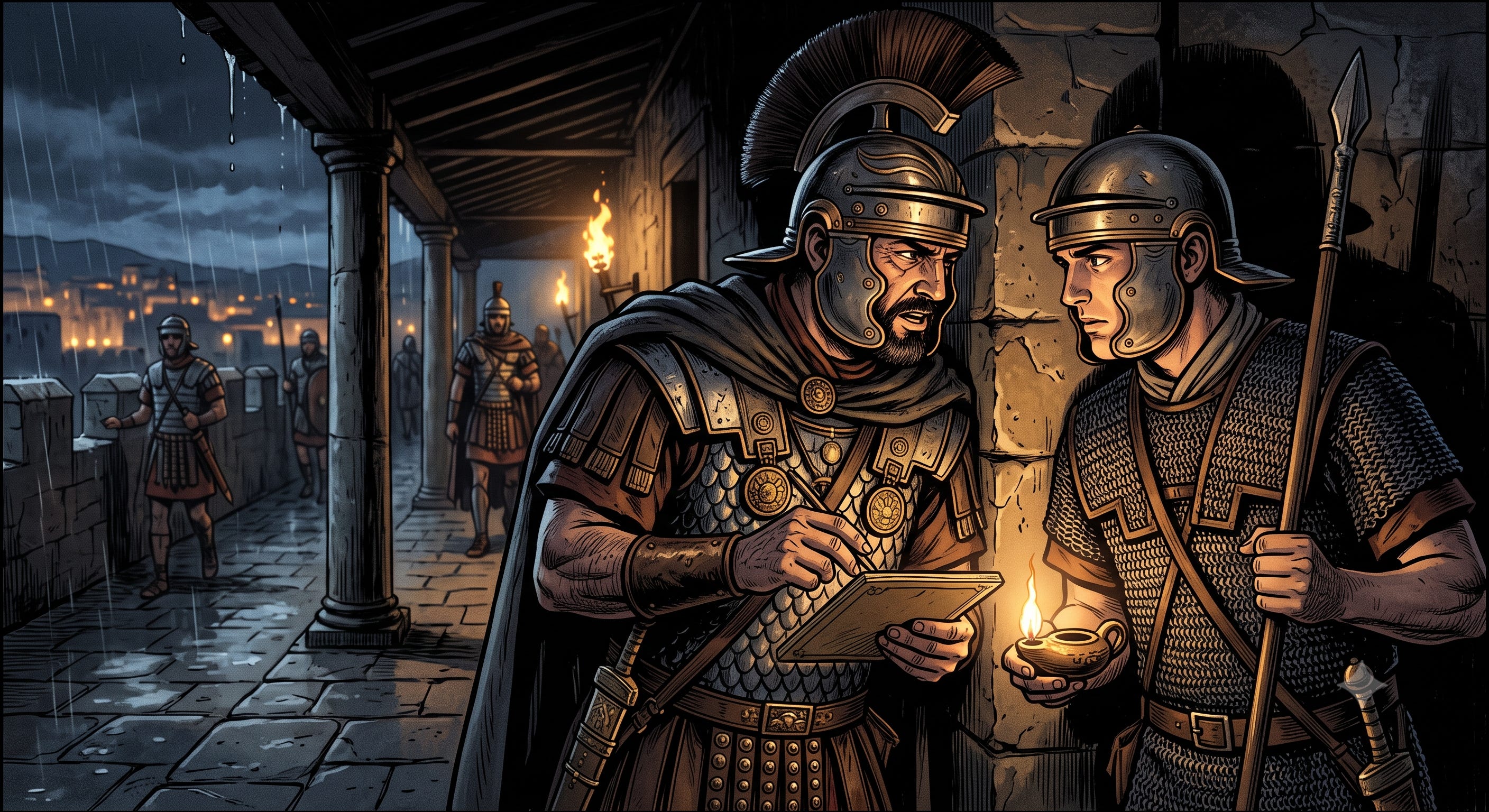
CENTURION MARIUS: A seasoned Roman commander of the Triari. Hardened, imposing, cloaked in heavy iron armor. Externally a brutal instrument of Caesar; secretly a leader in the Christian underground.
OPTIO VALERIUS: Marius’s young, fiercely loyal second-in-command. Quick-witted, deeply expressive, recently brought into the faith.
SETTING
The stone terrace of the Palatine Hill overlooking the ancient city of Rome.
TIME
Mid-First Century AD. The third watch of the night.
[SCENE START]
AT RISE:
A heavy, oppressive downpour drums against the stone stage. Torches flicker weakly in the distance, casting long, running shadows across the terrace.
CENTURION MARIUS stands downstage near the balustrade, cloaked in wet wool over his iron breastplate. He stares fixedly out over the sprawling, dark silhouette of Rome.
Marius slowly reaches beneath his breastplate, pulling out a small, damp fragment of papyrus. He touches it reverently, tracing the hidden script with his thumb.
MARIUS
(softly, reading aloud over the roar of the rain)
“If God is for us, who can be against us?” [1]
(a quiet, wry smile)
If Nero knew this text was resting against my ribs, Marius, you would be feeding the lions in the arena by dawn.
(He slips the papyrus back into his tunic and looks up at the sky)
They think they own us because we march under their eagle. They have no idea our true allegiance was bought by a crucified carpenter from Galilee.
(Sudden, heavy footsteps approach from upstage left. Marius’s posture changes instantly; his hand drops naturally to the hilt of his sword. He turns sharply, commanding the darkness.)
Who goes there?
(Enter OPTIO VALERIUS, breathless, checking over his shoulder into the wings before stepping into the torchlight. He drops into a swift, crisp military salute.)
VALERIUS
(urgently, keeping his voice low)
Sir. It’s Valerius. The prefect has just signed the warrant. They are moving on an apartment building near the Subura district. Third watch.
MARIUS
(body tensing into combat readiness)
The Subura? That valley is a tinderbox of tenement buildings. Why are they raiding a slum at midnight?
VALERIUS
They discovered that the physician, Luke, is sheltered there. He is writing down the accounts of the Judean teacher. They intend to arrest him and burn the manuscripts.
MARIUS
(inwardly shaken, taking a sharp step forward)
Burn them? If Luke’s writings are destroyed tonight, the historical record of the Gospel is permanently crippled. Papyrus and ink are too fragile, too expensive. A single successful raid could wipe those copies from the earth forever. How many men did the prefect allocate for the detail?
VALERIUS
A dozen auxiliaries, sir. They expect a simple civic raid. Should I run ahead? Warn the house-church to scatter?
MARIUS
No. A scattered flock is easily hunted. We do not survive Roman hostility by running, Valerius. We survive by becoming the very armor they wear.
VALERIUS
But sir, the warrant is signed by the Prefect himself. How do we fight that?
MARIUS
(stepping closer, his voice dropping into a fierce, conspiratorial whisper)
The same way the brothers before us did. Do you know how the network was forged, Valerius? How the Cohort of Christ was actually born?
(Valerius shakes his head, captivated by the sudden intensity in his commander’s eyes.)
MARIUS
It began with a single officer in Capernaum. He looked at the Nazarene and saw a Commander who could order sickness to halt with a word. [3] Then came Longinus at Golgotha, who watched the sky die and confessed the truth. [2] But the true, forged steel of our network? The men who built the deep roots? It was the Tomb Guards.
VALERIUS
(stunned)
The men who guarded the stone? But they claimed the disciples stole the body.
MARIUS
A lie bought with Caiaphas’s silver. [5] But you cannot un-see the glory of the divine, Valerius. The lie broke them. They couldn’t sleep. So, they used that high-priest silver. They bought influence. They bought transfers and promotions. They rose through the ranks of the Legions. And in secret, those promoted guards sought out Longinus, and they sought out the officer from Capernaum. They met in the shadows of the barracks and formally bound themselves to a new King.
(Marius begins to pace the terrace, the rain entirely ignored, fueled by the legacy of his brothers-in-arms.)
MARIUS
From that meetup, the chain of command grew. A shadow network passing the truth from garrison to garrison. It reached Caesarea, where our brother Cornelius actively sought out Simon Peter, bringing the Holy Spirit directly into the Roman ranks. [4] We became the secret shield of the Apostles.
VALERIUS
(a slow realization dawning)
Paul of Tarsus…
MARIUS
Exactly. When the Sanhedrin whipped up a mob to tear Paul apart in the Jerusalem temple, who do you think locked shields to pull him to safety? Our brothers in the garrison. [6] When Paul was shipwrecked on his way here to Rome, it was Centurion Julius of our Cohort who countermanded a direct kill order from his own men just to keep Paul breathing. [7] We do not draw our swords against Rome, Valerius. We use Rome’s own strict, complex laws as a shield for the saints.
VALERIUS
(a fierce grin spreading across his face)
Bureaucratic warfare.
MARIUS
(commanding, stepping into the center of the terrace)
Draft an emergency counter-order immediately. State that a suspected shipment of untaxed grain from Alexandria has been traced to that exact building in the Subura. By Imperial decree, economic contraband and tax fraud take immediate, absolute precedence over local civic disturbances. We are commandeering the raid.
VALERIUS
And what of the auxiliaries?
MARIUS
We will intercept them at the forum intersection. I will personally entangle them in a jurisdictional dispute over the paperwork until the fourth watch. By the time they clear the red tape, Luke will be escorted across the river, and the manuscripts will be secured in the underground vaults.
(Valerius nods eagerly, but pauses, a flicker of dread passing over his face. Marius notices the young soldier’s hesitation, softening his posture. He steps closer, placing a heavy, reassuring hand on Valerius’s shoulder armor.)
MARIUS
(voice shifting from commander to brother)
Look at me, Valerius. I know the dread you feel. I felt it too when I made my Initiation into this shadow cohort. But remember this: Rome believes it dictates the fate of the world with iron. But iron rusts. What we are protecting tonight will outlive every emperor who ever sits upon that throne. You are not merely saving a man. You are preserving the truth. Now, let us go play our part.
VALERIUS
(firmly, striking his breastplate)
Understood, Centurion. For the King.
(Valerius turns and exits quickly upstage left to draft the emergency orders.)
(Marius adjusts his military cloak with a crisp snap. He looks back out over the dark sprawl of Rome one final time, takes a deep breath, and steps resolutely out into the rain, marching downstage right toward the forum.)
[SCENE END]
HISTORICAL & BIBLICAL REFERENCES
[1] Romans 8:31
“What then shall we say to these things? If God is for us, who can be against us?”
[2] Matthew 27:54
“When the centurion and those who were with him, keeping watch over Jesus, saw the earthquake and what took place, they were filled with awe and said, ‘Truly this was the Son of God!’”
[3] Luke 7:9
“When Jesus heard these things, he marveled at him, and turning to the crowd that followed him, said, ‘I tell you, not even in Israel have I found such faith.’”
[4] Acts 10:1–2 & 44
“At Caesarea there was a man named Cornelius, a centurion of what was known as the Italian Cohort, a devout man who feared God with all his household, gave alms generously to the people, and prayed continually to God... While Peter was still saying these things, the Holy Spirit fell on all who heard the word.”
[5] Matthew 28:11-15
“Some of the guard went into the city and told the chief priests all that had taken place. And when they had assembled with the elders and taken counsel, they gave a sufficient sum of money to the soldiers and said, ‘Tell people, His disciples came by night and stole him away while we were asleep...’ So they took the money and did as they were directed.”
(This play speculatively explores the psychological aftermath of the guards, proposing they could not maintain the lie privately, used the silver to buy military promotions, and organized the first secret defection of Roman officers).
[6] Acts 21:31-32 & 23:23
“And as they were seeking to kill him, word came to the tribune of the cohort that all Jerusalem was in confusion. He at once took soldiers and centurions and ran down to them... Then he called two of the centurions and said, ‘Get ready two hundred soldiers, with seventy horsemen and two hundred spearmen to go as far as Caesarea at the third hour of the night.’”
[7] Acts 27:42–43
“The soldiers’ plan was to kill the prisoners, lest any should swim away and escape. But the centurion, wishing to save Paul, kept them from carrying out their plan. He ordered those who could swim to jump overboard first and make for the land...”