


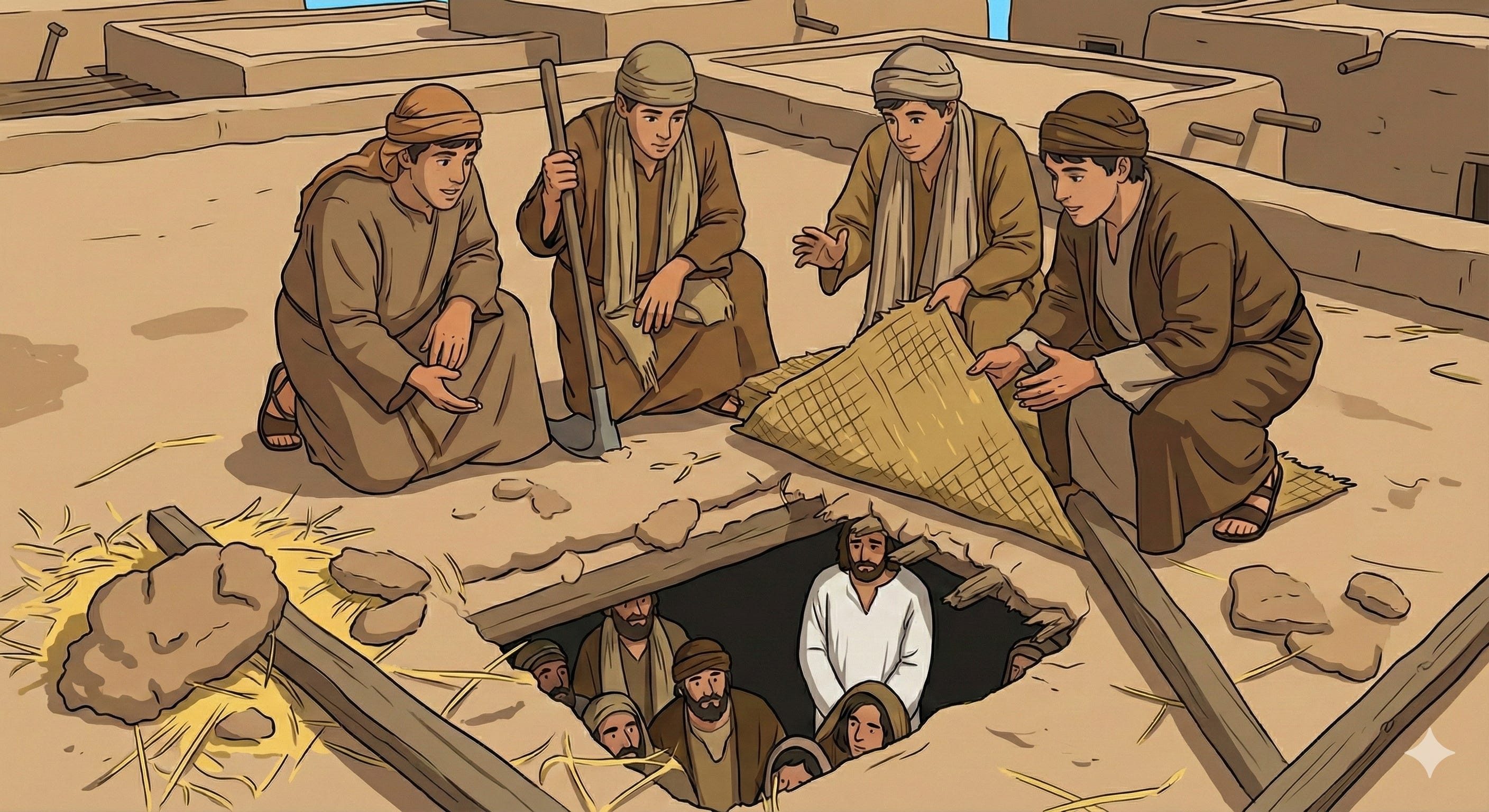
We know they tore the house apart to get to Jesus. But what happened when the sun went down?
(Note to Reader: This narrative gap is based on the accounts in Matthew 9, Mark 2, and Luke 5. While the miracle is scriptural, the character names and the specific conversation about the repairs are a creative reimagining to explore the human side of the Gospel.)
It is one of the most beloved scenes in the Gospels. Four desperate friends carrying a paralyzed man. A crowd so thick it blocks the door. A wild idea to climb the stairs, dig through the clay and thatch, and lower their friend right in front of the Son of God.
We love the audacity of it. We love the "interruption." We love that Jesus looks up, sees their faith, and commands the man to walk.
But yesterday, I’ve been thinking about the scene that happened after the scene.
I’ve been thinking about the hole in the ceiling.
The Argument on the Stairs
Imagine the group for a moment. Let’s give them names. There’s Caleb, the initiator who refuses to take no for an answer. There’s Thomas, the skeptic who calculates the risks. There’s Jude, the muscle, and Levi, the negotiator. And on the mat lies Elian, a man who hasn’t felt his legs in years.
When they arrive at the house in Capernaum, Thomas likely points out the obvious: "It’s over. We can’t get in. The crowd is too dense."
But Caleb looks up. "We don't go through. We go over."
I imagine the argument on the stairs was intense. To dig through a 1st-century Palestinian roof wasn't just rude; it was destruction of property. It was digging through baked mud, heavy beams, and brushwood. It meant raining debris down on a Rabbi.
Thomas would have argued, "We’ll be arrested!" Levi would have worried, "We can’t afford the damages!" But they dug anyway. They broke the barrier because their love for their friend outweighed their fear of propriety.
The Theology of Repair
We know the middle of the story. The dust falls. The Pharisees scoff. Jesus speaks. Elian stands up, grabs his mat, and dances out the door.
But here is where our imagination needs to finish the work.
The sun sets. The crowd disperses. Jesus moves on to the shore. What happens to the roof?
I like to believe that the four friends didn’t just run off to the tavern to celebrate. I believe they went back up the stairs. And this time, Elian—the young man who had been carried up—walked up beside them.
Imagine them there in the twilight, mixing fresh mud, re-weaving the thatch, and passing buckets to one another.
"I can't believe I'm doing this," Elian might have laughed, balancing on the edge of the roof—a dangerous place for one who was paralyzed that morning. "I'm fixing the hole I came through."
There is a lesson here: Faith gives us the boldness to break through, but gratitude gives us the integrity to build back up.
Stewardship of the Miracle
In our walk with God, we often focus on the "breaking." We break through our fears, our addictions, or our pride to get to the feet of Jesus. We make a mess of things in our desperation. And God, in His grace, honors that desperation. He heals us.
But true discipleship involves the stewardship of that healing.
If God heals your marriage, you still have to do the work of rebuilding trust. If God delivers you from a financial crisis, you still have to pay your debts. If God forgives your past anger, you may still need to go back and apologize to the people you hurt.
The friends in Capernaum became the "Roof Breakers," but they also became the repair crew. They didn't fix the roof to earn the miracle; they fixed it because they were thankful for it.
Your Turn to Climb
Perhaps you are standing outside a crowded room today. You feel paralyzed by a circumstance, or you are carrying a friend who is.
Do not be afraid to grab the trowel. Do not be afraid to disrupt the status quo to get to Jesus. Dig the hole.
But remember, once the healing comes—and it will—do not just walk away. Stand up on your new, strong legs, and help your brothers fix the roof. That is where the fellowship is sweetest: not just in the receiving of the gift, but in the work of the restoration.
-30-