


Ayaan Hirsi Ali has always been a woman of deep conviction. From her escape from an arranged marriage and her renunciation of Islam in 2002 to her rise as a leading "New Atheist," she has never shied away from the center of intellectual conflict. However, on November 11, 2023, she ignited a different kind of conversation.
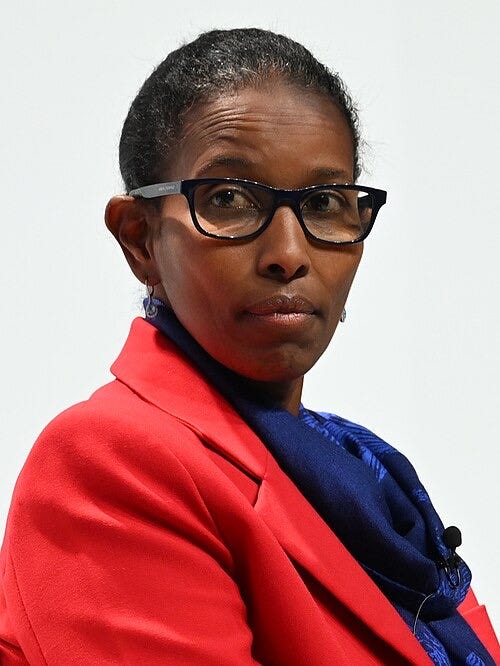
In her landmark essay "Why I am now a Christian," published in UnHerd, Hirsi Ali revealed a shift. She wasn't just changing her mind; she was changing her foundation.
The Civilizational Shield
For Hirsi Ali, this conversion is partly a matter of survival—specifically for the West. She argues that the freedoms we often take for granted—freedom of speech, freedom of conscience, and individual rights—are not universal defaults. Instead, they are the unique products of the Judeo-Christian tradition.
In her view, secularism and "New Atheism" lack the structural integrity to withstand modern "menacing foes." She cites the rise of global authoritarianism and radical ideologies as forces that cannot be countered by logic alone. To Hirsi Ali, Christianity is the "wood" of our civilization; without it, the house cannot stand.
Filling the "God-Hole"
Beyond the geopolitical arguments, there is a deeply personal core to her story. Hirsi Ali candidly described atheism as "spiritually bankrupt." She spoke of a "God-hole" left by the retreat of faith—a void that she believes is often filled by irrational dogmas and a sense of nihilism.
After years of searching for meaning through pure reason, she found that life without spiritual solace was becoming increasingly difficult to navigate. She now points to the "living waters" of faith as a source of strength, providing a better framework for addressing the fundamental human need for purpose and meaning.
A Student of the Faith
Today, Hirsi Ali describes herself not as a theological expert, but as a "learner." She attends church services, reads the scriptures, and is exploring a faith that she says emphasizes compassion and humility over the rigid dogmas of her past. Her journey serves as a powerful reminder that the search for a moral and spiritual anchor is a continuous process, even for the most seasoned skeptics.